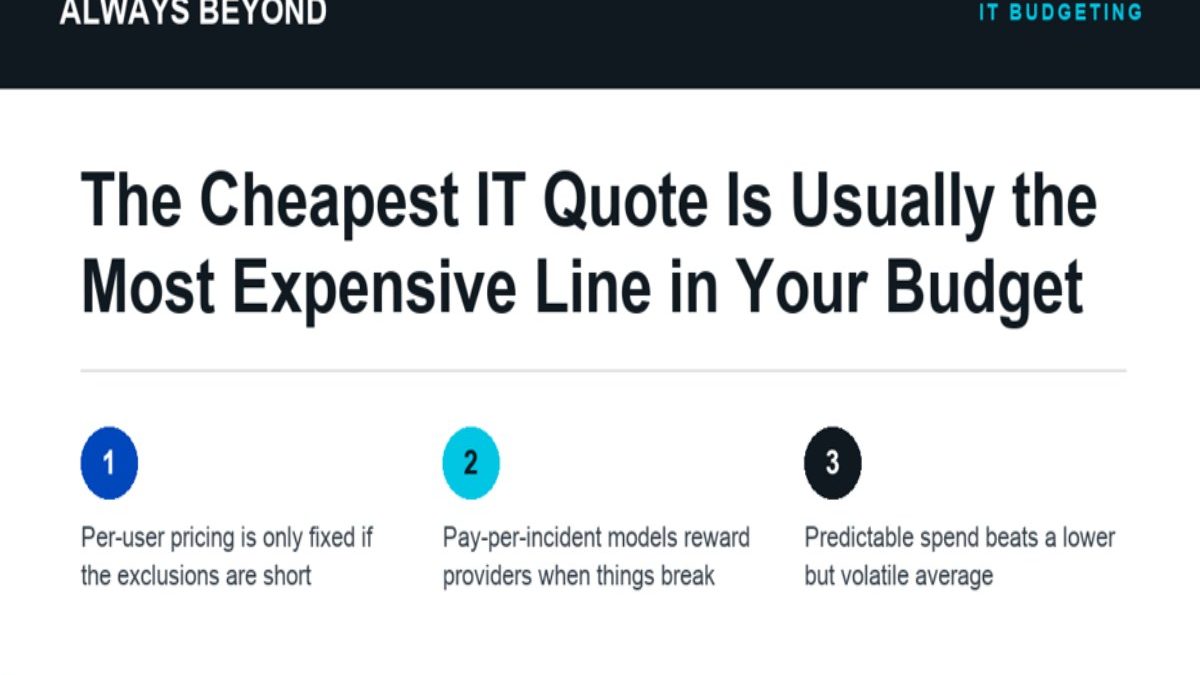
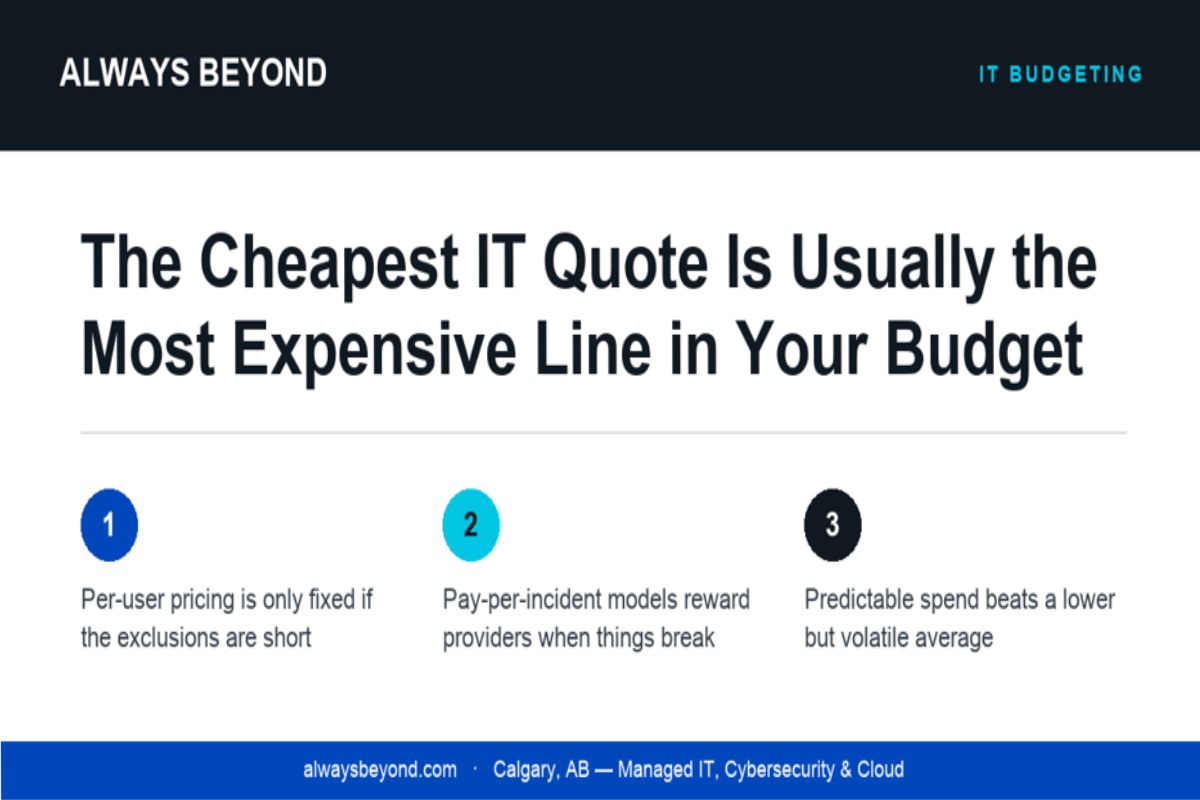
Ask a CFO what they dislike most about the IT line in the budget, and the answer is rarely the size of it. It is the shape. A number that sits politely at one figure for three months, then doubles in a single quarter because a server died, a laptop order went sideways, and someone had to be paid overtime to recover a mailbox. Finance people can live with costs. What they cannot live with is surprise.
That is the lens I would bring to any IT proposal, and it is why the question finance teams ask when they go shopping, “who is the best MSP in Calgary for our budget?”, is usually asked backwards. Most companies start by comparing the monthly figure. They should start by asking how likely that figure is to stay true.
Table of Contents
Per-user pricing, read properly
Per-user pricing has become the default for managed IT, and on paper it is a gift to anyone building a forecast. Headcount goes up, cost goes up in a straight line. You can model it in minutes.
The trouble is that “per user” can mean very different things depending on what sits underneath it. In one proposal it covers the help desk, security monitoring, patching, onboarding, and after-hours support. In another it covers the help desk during business hours, and everything else arrives as a separate invoice with an hourly rate attached. Both quotes use the same unit. Only one of them is a real fixed cost.
So the first job is translation. Take each proposal and sort every service into two columns: included in the per-user figure, or billed when it happens. The second column is where your variance lives. If it is long, that low monthly number is not a price. It is a deposit.
How the cheap quote gets expensive
The lowest bid tends to win the spreadsheet comparison because spreadsheets compare what is written down. What is not written down is the behaviour the pricing model encourages.
When a provider earns extra on every project, every new hire setup, and every hour outside the base scope, its incentives quietly drift away from yours. It is not dishonest, just arithmetic. A provider paid more when things break has no financial reason to make sure things break less. A provider paid the same whether your month is calm or chaotic has every reason to keep it calm, because chaos comes out of its own margin.
There are softer costs too. Staff waiting on slow support do not appear as an IT expense, but their time is still on the payroll. An office manager who has quietly become the unofficial help desk is a salary spent on the wrong work. None of this shows up on the vendor invoice, which is exactly why the cheapest invoice can hide the most expensive arrangement.
What predictable actually looks like
If I were reviewing IT spend for a growing company, here is the short checklist I would want answered in writing before signing anything.
| Question | Why it matters to finance |
| What is excluded from the monthly fee? | Exclusions are your unbudgeted spend |
| Are there onboarding or setup fees? | One-time costs distort first-year comparisons |
| How long is the contract, and how does it renew? | Lock-in limits your ability to correct a bad decision |
| Are there tiers, and which one fits us? | Tier jumps create step changes in cost |
| What happens to pricing as headcount grows? | Your forecast depends on it |
A provider with clean answers to all five is offering something a finance team can actually plan around. A provider who hedges on two or three is offering a starting price.
The budget conversation worth having
There is a reasonable case for paying a little more per month in exchange for a number that does not move. Predictable spend is easier to approve, easier to defend at a board meeting, and easier to scale against a hiring plan. Volatile spend, even if it averages lower, eats management time every time it spikes, and it always spikes at the worst moment.
Before the next renewal lands on your desk, ask your current provider for a twelve-month list of everything you paid beyond the base fee. If that list is short, you are in good shape. If it is long, you already know what your real monthly rate is, and it is not the one on the contract.
Also Read: ATM Outsourcing Explained: A Practical Guide for Business Owners