
Table of Contents
Suo Moto Meaning in India – Complete Guide (2026)
Introduction
The term “Suo Moto” (also spelled Suo Motu) is widely used in Indian legal discussions, especially in news related to courts and governance. You may often hear phrases like “Court took suo motu cognizance” or “High Court initiated suo moto action.” But what does it actually mean?
In simple terms, “suo moto” means “on its own motion”—a Latin expression used when a court or authority takes action without any formal complaint or petition.
In India, this concept plays a critical role in protecting public interest, fundamental rights, and justice, especially when people are unable to approach the courts themselves.
Meaning of Suo Moto (Simple Explanation)
| Term | Meaning |
| Suo Moto | “On its own motion” (Latin) |
| Legal Meaning | Court takes action without a petition |
| Common Usage | Courts, government authorities |
| Purpose | Protect justice and public interest |
In easy language:
When a court itself starts a case without anyone filing it, it is called a “suo moto case.”
Origin of the Term
“Suo moto” comes from Latin legal terminology, widely used in courts across the world.
Key Facts
| Aspect | Details |
| Language | Latin |
| Original Phrase | Suo motu |
| Literal Meaning | On its own initiative |
| Similar Term | Sua sponte |
The concept became popular in India through judicial activism in the late 20th century, especially with the rise of Public Interest Litigation (PIL).
Suo Moto in Indian Law
In India, suo moto powers are mainly exercised by:
- Supreme Court
- High Courts
- Sometimes regulatory or administrative authorities
These powers are derived from constitutional provisions like:
| Article | Description |
| Article 32 | Right to constitutional remedies (Supreme Court) |
| Article 226 | Power of High Courts to issue writs |
Although the term “suo moto” is not explicitly written in the Constitution, courts have interpreted these articles to allow such actions.
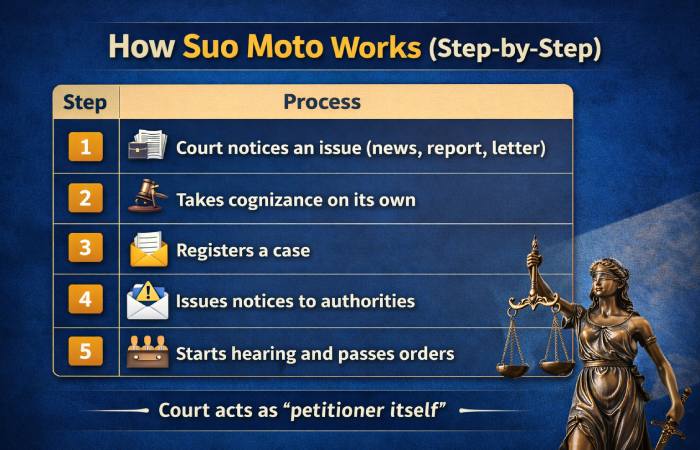
How Suo Moto Works (Step-by-Step)
| Step | Process |
| 1 | Court notices an issue (news, report, letter) |
| 2 | Takes cognizance on its own |
| 3 | Registers a case |
| 4 | Issues notices to authorities |
| 5 | Starts hearing and passes orders |
The court acts like a “petitioner itself” in such cases.
When Do Courts Take Suo Moto Action?
Courts usually take suo moto action in serious situations:
Common Situations
| Situation | Example |
| Human rights violations | Custodial deaths |
| Environmental issues | Pollution cases |
| Public safety concerns | Building collapses |
| Government failure | Delay in welfare schemes |
| Media reports | Major incidents reported in news |
Courts intervene when there is a “grave injustice” or failure of authorities.
Real Examples of Suo Moto in India
1. COVID-19 Crisis
The Supreme Court took suo moto action to manage oxygen supply, migrant issues, and healthcare.
2. Digital Arrest Scam
The court initiated action against fraudsters misusing legal authority.
3. Prison Overcrowding
High Courts acted suo moto following Supreme Court directions.
4. Noise Pollution
Courts questioned authorities for not acting on their own.
Key Features of Suo Moto Power
| Feature | Explanation |
| No petition required | Court acts independently |
| Focus on public interest | Helps society at large |
| Quick intervention | Faster justice |
| Judicial activism | Courts take proactive role |
| Flexible procedure | Not bound by strict formalities |
Difference Between Suo Moto and PIL
| Basis | Suo Moto | PIL (Public Interest Litigation) |
| Who files case | Court itself | Citizen/NGO |
| Need for petition | No | Yes |
| Purpose | Immediate justice | Public welfare |
| Initiation | Court-driven | Public-driven |
Both aim to protect public interest, but the process differs.
Advantages of Suo Moto Action
1. Faster Justice
Courts can act immediately without waiting for complaints.
2. Protection of Vulnerable People
Helps those who cannot approach courts due to poverty or fear.
3. Accountability of Authorities
Government agencies are forced to act responsibly.
4. Promotes Judicial Activism
Strengthens democracy and rule of law.
Disadvantages and Criticism
| Issue | Explanation |
| Judicial overreach | Courts may interfere too much |
| Lack of procedure | Sometimes unclear process |
| Political sensitivity | May affect government decisions |
| Workload burden | Courts already overloaded |
Some critics argue that excessive use of suo moto powers can blur the separation of powers.
Role of Media in Suo Moto Cases
Media plays a crucial role:
| Media Source | Impact |
| News reports | Trigger court action |
| Social media | Highlights public issues |
| Investigations | Provide evidence |
Many suo moto cases start after courts read newspapers or online reports.
Suo Moto Cognizance – What It Means
The term “cognizance” refers to taking notice of an issue.
| Term | Meaning |
| Cognizance | Court taking notice |
| Suo Moto Cognizance | Court taking notice on its own |
Legal Basis of Suo Moto in India
| Legal Principle | Explanation |
| Judicial Review | Courts can review actions of government |
| Fundamental Rights | Protect citizens’ rights |
| Rule of Law | Ensure fairness |
| Natural Justice | Prevent injustice |
These principles empower courts to act even without a complaint.
Importance in Indian Democracy
Suo moto power is considered a cornerstone of judicial activism in India.
Why It Matters
- Ensures justice even when citizens are silent
- Keeps government accountable
- Protects constitutional values
- Acts as a safeguard against injustice
Common Misconceptions
| Myth | Reality |
| Only Supreme Court can use it | High Courts also can |
| It replaces normal cases | It is used only in special cases |
| Anyone can demand it | Court decides itself |
| It is written in Constitution | It is derived through interpretation |
FAQs on Suo Moto Meaning
1. What is suo moto in simple words?
It means court taking action on its own without a complaint.
2. Who can take suo moto action in India?
Mainly Supreme Court and High Courts.
3. Is suo moto written in the Constitution?
No, but it is derived from Articles 32 and 226.
4. Why is suo moto important?
It ensures justice for people who cannot approach courts.
5. What is an example of suo moto?
Court acting on news reports about human rights violations.
Conclusion
The concept of suo moto reflects the proactive role of the Indian judiciary in ensuring justice. By allowing courts to act “on their own motion,” it bridges the gap between law and society, especially for those who lack access to legal resources.
While it has some criticisms, its benefits in safeguarding fundamental rights, public interest, and democracy make it an essential feature of India’s legal system.