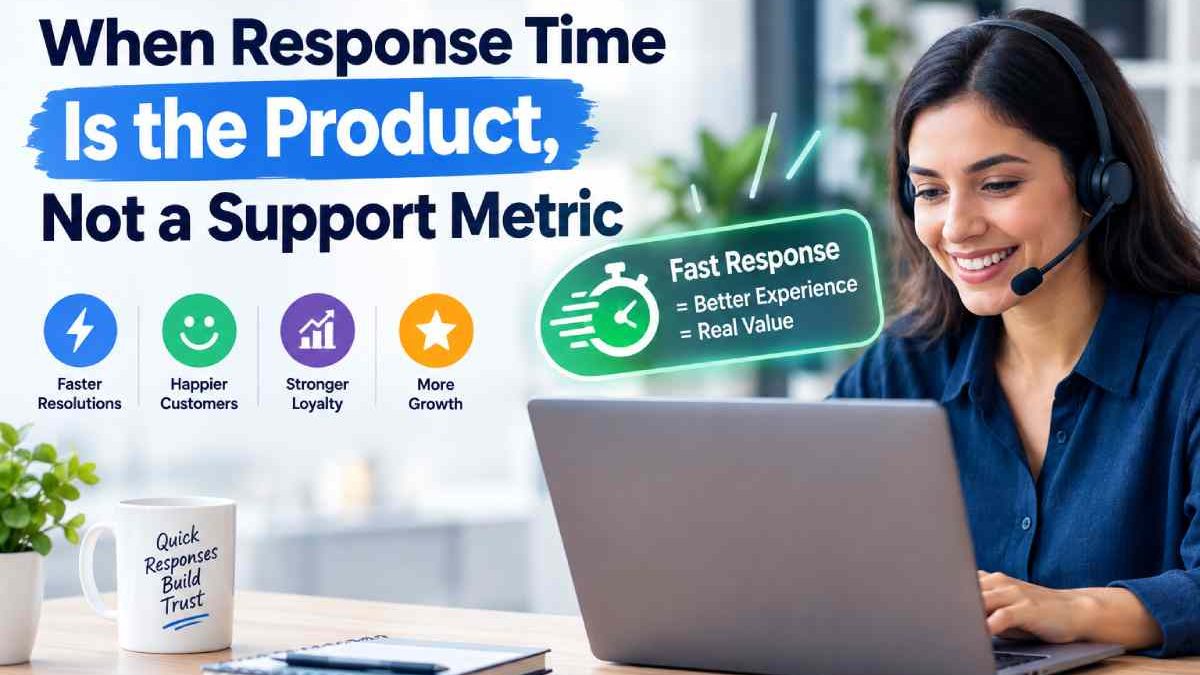
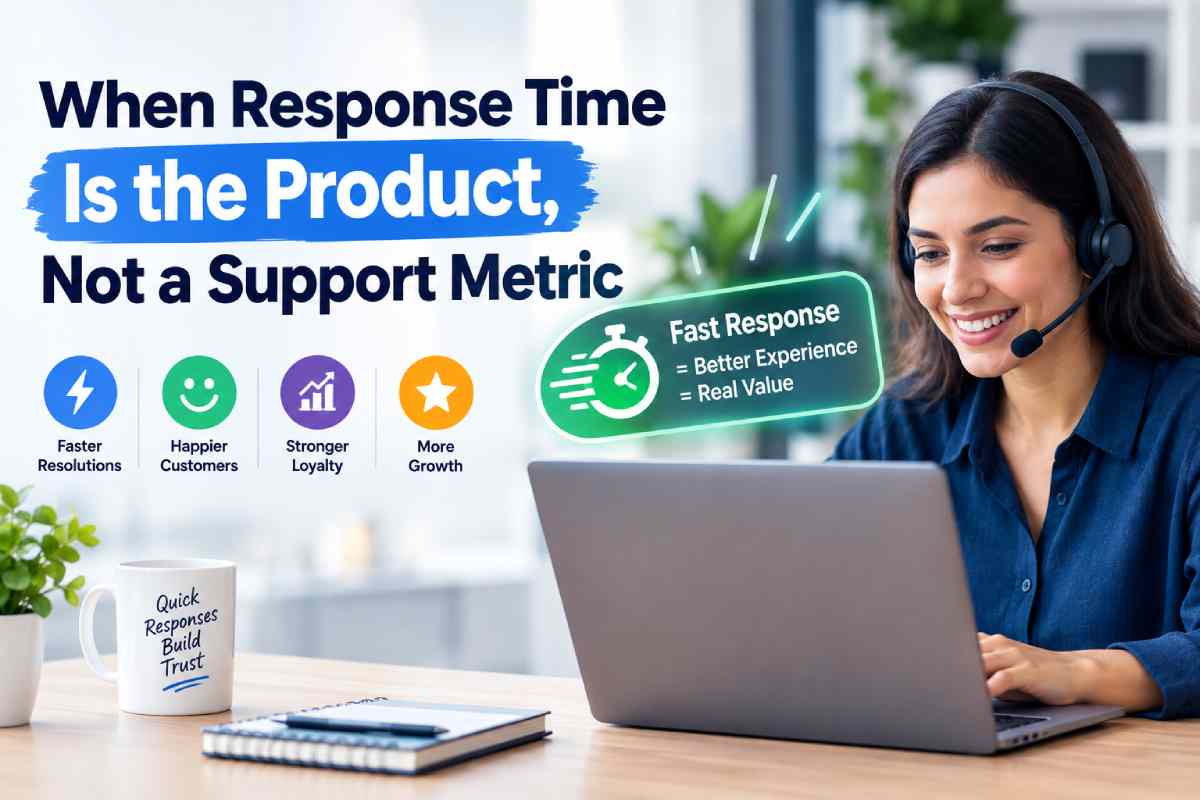
Most companies treat customer support as a cost centre that protects the product. In a surprising number of businesses, the support conversation *is* the product, and everything else is marketing material that leads to it.
This is true wherever a customer has to trust a stranger with money before receiving anything. Tuition platforms, repair services, travel agents, insurance brokers, freelance marketplaces and a long tail of chat-first businesses all share the same shape: the thing being bought is partly reassurance, and reassurance has a response time.
If that describes your business, several conventional support practices are actively harmful, and the metrics most teams report are measuring the wrong thing.
Table of Contents
Anxiety Sets the Clock
The speed a customer expects is not set by your category. It is set by how nervous they are.
Someone browsing a catalogue will happily wait a day for an email. Someone about to send money to a business they discovered twenty minutes ago is in a completely different state. They are looking for reasons to stop, and silence is the easiest reason available.
In that window, a fast and specific reply does something no landing page can. It proves a human is attached to the business, that the human understands the question, and that there will be someone to talk to if things go wrong later. Those three facts are what the customer is actually buying.
The corollary is uncomfortable: a brilliant product with slow first replies will lose to a competent product with fast ones, in any category where the purchase feels risky.
Specific Beats Fast
Speed alone is not enough, and this is where many teams over-correct.
A reply in ten seconds that says “Thanks for reaching out! How can I help you today?” after the customer has already explained their question is worse than two minutes of silence. It proves nobody read the message. Customers in an anxious state read that as a bot, and a bot is exactly what they feared.
The target is a first reply that demonstrably answers the specific thing asked, even if the full resolution takes longer. “Yes, that platform supports UPI, and withdrawals go back to the same account. Let me check the current timing and confirm in a minute” is a far stronger opening than an instant greeting.
Train for comprehension before speed. A team that reads properly and replies in ninety seconds outperforms one that fires acknowledgements in five.
Demand Is Spiky, Not Steady
Staffing models built on average daily volume fail in any business tied to events.
A business serving cricket fans does not get a smooth distribution of enquiries. It gets near-silence on a Tuesday afternoon and a wall of messages in the hour before a big match, with a second peak in the minutes after it ends. Retail has sale days, travel has long weekends, education has admission season.
Categories where support is effectively the product, such as the cricket ID services that run their entire customer journey through WhatsApp, staff against the fixture list rather than against the clock. The same instinct applies anywhere demand is event-driven: build the roster around the calendar that drives your customers, not around office hours.
Three practical consequences:
- Over-staff the peak deliberately. The cost of idle capacity on a quiet afternoon is far lower than the cost of a 40-minute queue during the one hour that matters.
- Shift the queue where you can. Pre-match reminders and prepared answers to predictable questions reduce the spike before it forms.
- Measure response time during peaks only. A daily average hides exactly the period that decides your reputation.
What to Automate, and What Never To
Automation in a trust-driven business has a narrow safe zone.
Safe to automate: status lookups, order and payment references, documents the customer already has a right to, business hours, published prices, and a holding message that includes a realistic wait estimate.
Dangerous to automate: the first reply to a new customer, anything involving money that has gone missing, complaints, and any conversation where the customer has already said they are worried. Those are precisely the moments where a template reads as indifference.
The hybrid that works is a bot that collects context and never pretends to be a person, followed by a human who clearly has that context. What fails is a bot that attempts conversation and hands over a transcript the human ignores, forcing the customer to repeat themselves. Repetition is the single most reliable way to destroy the goodwill a fast reply just earned.
Language Is Not a Feature Flag
Multilingual support is often implemented as a translated interface and a language dropdown. In practice, customers in high-anxiety moments revert to their most comfortable language regardless of what the interface says.
Staffing people who speak that language is the real localisation. It costs more than translation and works dramatically better, because the register matters as much as the vocabulary. A customer writing in a mix of two languages wants a reply in the same mix, not a formally correct translation that reads like a notice.
This is also a retention lever. The agent who resolved a problem in the customer’s own language becomes a person, and people are harder to churn away from than brands.
What a Good First Reply Contains
Teams improve far faster from a worked example than from a principle, so here is the anatomy of a reply that works in a high-anxiety moment.
It names the thing asked about, so the customer knows they were read. It answers the direct question, even partially, before anything else. It states what happens next and when, because an uncertain wait is worse than a long one. And it gives the customer something to do or check, which converts helplessness into participation.
Compare two openings to the same question about a delayed payment. “Hi! Thanks for contacting us. Please share your registered number” puts the work back on the customer and tells them nothing. “Payments from that bank usually land within two hours, and yours was initiated at 4:40pm. Send me the reference number from your app and I’ll check where it is right now” answers, reassures, sets a timeframe and makes a specific request.
Neither reply took longer to write. One of them keeps the customer.
Hiring and Training for This
If support carries the sale, the hiring profile changes.
The traits that matter most are reading comprehension, comfort with ambiguity and the willingness to say “I don’t know, let me check” without panic. Product knowledge is trainable in a week; the instinct to read a worried message properly is not.
Scripts should exist as reference material rather than as lines to recite. The useful artefact is a short internal document of the twelve questions that actually get asked, each with the facts needed to answer and the boundaries of what can be promised. Agents who know the facts can write in their own voice, which is what customers respond to.
Quality review should sample the opening message of new conversations, not just the ones that ended badly. By the time a conversation goes wrong, the damage usually happened in the first reply.
Metrics That Predict Retention
Most support dashboards lead with ticket volume, average handling time and customer satisfaction scores. For trust-driven businesses, those are weak predictors.
Better ones:
- First response time at the 90th percentile, measured during peak hours. Averages hide the customers who waited longest, and those are the ones who leave.
- First contact resolution rate. How often a question is answered without a handoff, a callback or a repeat message.
- Repeat-contact rate within 24 hours. A customer coming back the next day usually means the first answer did not land.
- Reopen rate after “resolved”. The honest measure of whether the resolution was real.
- Conversion from first message to first transaction, for businesses where support is the sales channel. This is the metric that proves support is the product.
Average handling time deserves particular suspicion. Optimising it pushes agents to close conversations quickly, which is the opposite of what a nervous customer needs.
Escalation Should Be Visible
Every support system needs a path for the cases that do not fit, and customers should be able to see it.
Publishing a named escalation route, whether a senior contact, a complaints address or an expected timeline, costs little and changes the tone of difficult conversations. A customer who knows there is a next step argues less, because they are no longer fighting to be taken seriously.
The absence of that path is also one of the clearest signals of a business worth avoiding, which is why scammers never publish one.
When Chat Is the Wrong Answer
Chat-first support has real limits, and pretending otherwise leads to bad decisions.
It scales poorly with headcount, because every conversation consumes a person. It produces weak records unless there is deliberate logging, which matters when disputes arise. It makes consistency hard, since two agents can give two answers. And it puts your customer relationships inside a platform you do not own, which is a strategic risk when numbers can be banned.
The businesses that handle this well treat chat as the front door while building the infrastructure behind it: documented answers, a searchable history, published policies and a second channel customers can reach if the first disappears.
The Underlying Principle
The question worth asking is not “how fast is our support?” but “what is the customer actually buying?”
Where the answer includes confidence, reassurance or the belief that someone will be there afterwards, support is not supporting the product. It is the product, and it deserves the staffing, the metrics and the design attention that implies.
Everything else, from the website to the pricing page to the testimonials, exists to get the customer as far as the first message.
Also Read: Improve your Digital Marketing Skills – 4 Skills for Marketing