

Table of Contents
What this guide covers
- The four main debt-relief paths differ sharply in cost, credit impact and duration, and matching the path to the client matters more than any single feature.
- Consolidation and credit counselling suit clients whose income can service the full debt, while formal insolvency tools exist for clients whose income cannot.
- Canada’s consumer proposal has no direct U.S. equivalent, and advisors with Canadian clients encounter it more often than they expect.
- A client in debt distress is a retention moment, because the advisor who navigates it well keeps the relationship for decades.
Advisors are trained for accumulation, and the profession’s tools reflect it. Yet a meaningful share of clients will pass through a period of genuine debt distress, often hidden behind a healthy income. The advisor’s response in that window shapes the relationship more than any allocation decision ever will. The four paths below are the realistic menu. Knowing which client belongs on which path is the difference between a referral made with confidence and a client quietly disappearing into a debt-settlement ad.
Consolidation works when the income can carry the debt
A consolidation loan or line of credit gathers scattered balances into one payment at a lower blended rate, and for the right client it is the cleanest exit available. The right client has stable income sufficient to service the full principal and a credit file strong enough to qualify for a rate that actually improves things. They also need a spending pattern that will not refill the cards the loan just emptied.
That last condition fails more often than the first two. Consolidation restructures debt without reducing it, so an advisor recommending this path should pair it with a hard look at the cash-flow habits that built the balances, or the client returns in eighteen months with the loan and the cards both full.
Credit counselling trades cost for time
A debt management plan through a non-profit credit counselling agency consolidates unsecured debts into one payment over three to five years, usually with creditors agreeing to reduce or waive interest. The principal still gets repaid in full, the plan appears on the credit file while active, and completion rates depend heavily on the client’s income stability.
The Financial Consumer Agency of Canada maintains plain-language guidance on managing debt and on the cost of high-interest borrowing that advisors can hand to clients without endorsement risk, which is useful when a client is drifting toward expensive stopgaps while deciding on a path.
The consumer proposal is the tool advisors outside Canada have never met
For Canadian clients whose debts exceed what their income can realistically repay, a consumer proposal occupies the wide middle ground between a management plan and bankruptcy. Filed through a Licensed Insolvency Trustee under the Bankruptcy and Insolvency Act, it is a legally binding settlement in which creditors accept a portion of the unsecured debt, repaid over up to five years. The client keeps their assets and gains immediate protection from collections and wage garnishment on the day of filing.
Advisors with Canadian clients should take ten minutes to learn about consumer proposals before the word bankruptcy ever enters a client conversation, because the proposal resolves many situations that clients assume require one. The Office of the Superintendent of Bankruptcy publishes the formal consumer guidance, and the credit impact is real but bounded: Equifax notes that a proposal remains on the file for three years after completion, which is materially shorter than the shadow a bankruptcy casts.
The planning consequences are what the client’s trustee will not model and the advisor should. RRSP contributions during a proposal, insurance premiums that must survive the payment plan, and the rebuild sequence afterward all sit squarely in the advisor’s lane, and clients navigating a proposal with their advisor still engaged emerge as fiercely loyal clients.
Bankruptcy is the floor, and knowing the floor has value
Personal bankruptcy discharges most unsecured debt, costs surplus-income payments and possibly assets, and marks the credit file for six to seven years on a first filing. For a client with no realistic repayment capacity it remains the correct answer, and treating it as unspeakable serves nobody.
What an advisor contributes here is sequence and referral quality. Insolvency filings run through licensed professionals, the client’s investment accounts and exempt assets need review before filing rather than after, and the post-discharge rebuild is a planning engagement in its own right.
The advisor’s job is triage, not treatment
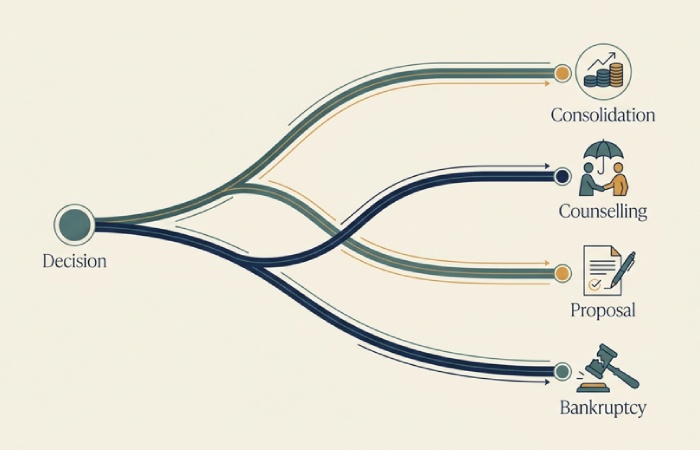
None of these paths is the advisor’s to execute, and all of them are the advisor’s to understand. The triage logic is compact: income that covers the debt comfortably points to consolidation, while income that covers it only with discipline points to counselling. Income that cannot cover the debt points to a proposal, and no realistic capacity points to bankruptcy. A client who hears that logic from their advisor, calmly and without judgment, has been given something the debt-relief industry’s advertising never offers.
The clients most likely to need this conversation are often the ones who look least likely to need it. Start it early, know the referral names in each jurisdiction before the first crisis, and the distress becomes a chapter in a long relationship rather than the end of one.
Also Read: Why a Financial Plan Should Connect Every Part of Your Money